Download free PDF

U.S. E-Bike Market Size & Share 2026-2035

Market Size By - Class (Class 1, Class 2, Class 3); By Battery (Lithium-ion, Lead Acid, Others); By Motor (Hub Motor, Mid Motor); By Propulsion (Pedal Assist, Throttle Control); By Ownership (Shared, Personal); By Power Output (Below 250W, 250W to 750W, Above 750W); By Sales Channel (Online, Offline); By Application (City/Urban, Trekking, Cargo, Mountain/Off-Road, Others) - Growth Forecast. The market forecasts are provided in terms of value (USD) & shipment (Units).

Report ID: GMI14467
   |
Published Date: March 2026
 | 
Report Format: PDF

Download Free PDF

U.S. E-Bike Market Size

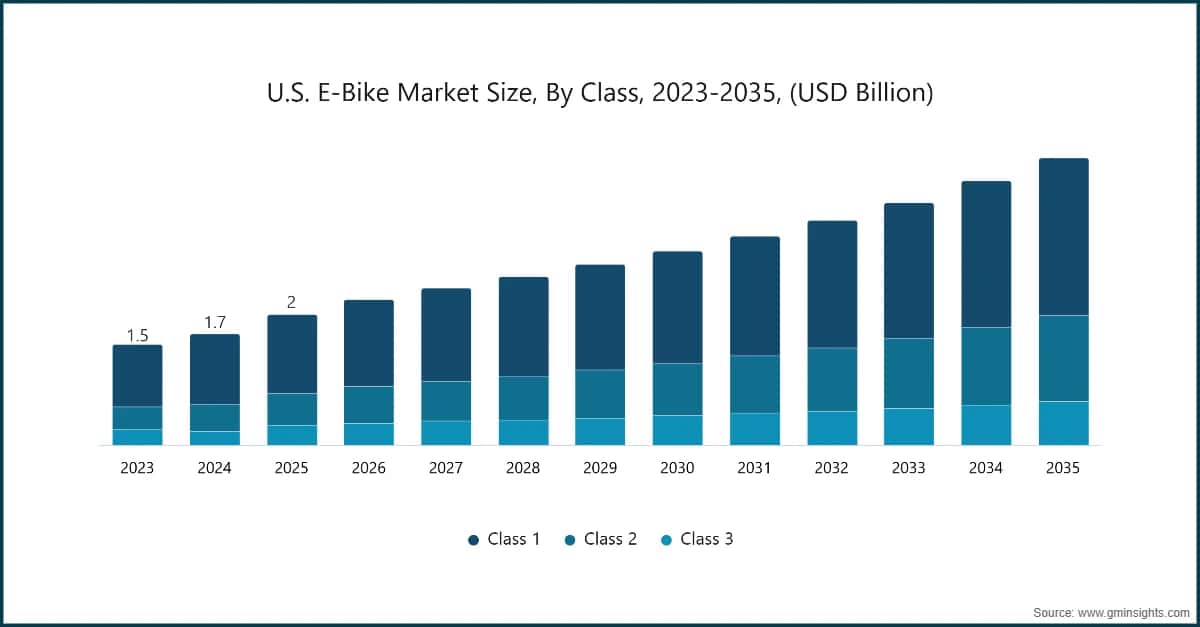
The U.S. e-bike market was estimated at USD 2 billion in 2025. The market is expected to grow from USD 2.2 billion in 2026 to USD 4.3 billion in 2035, at a CAGR of 7.8% according to latest report published by Global Market Insights Inc.

U.S. E-Bike Market Key Takeaways

Market Size & Growth

  • 2025 Market Size: USD 2 Billion
  • 2026 Market Size: USD 2.2 Billion
  • 2035 Forecast Market Size: USD 4.3 Billion
  • CAGR (2026–2035): 7.8%

Regional Dominance

  • Largest Market: California
  • Fastest Growing Country: Texas

Key Market Drivers

  • Rising demand for sustainable urban mobility.
  • Expansion of cycling infrastructure.
  • Technological advancements in battery and motor systems.
  • Growth of last-mile delivery and micro-mobility services.
  • Increasing popularity of recreational and fitness cycling.

Challenges

  • High upfront purchase cost.
  • Battery replacement and maintenance costs.
  • Regulatory and classification variations.
  • Supply chain dependency.

Opportunity

  • Expansion of cargo and utility e-bikes.
  • Integration of smart and connected features.
  • Growth of subscription and bike-sharing models.
  • Corporate and government incentive programs.

Key Players

  • Market Leader: Pon led with over 9% market share in 2025.
  • Leading Players: Top 5 players in this market include Accell, Giant Manufacturing, Pon, Specialized Bicycle Components, Trek Bicycle, which collectively held a market share of 33% in 2025.
The increase in congestion and rising fuel prices in the major U.S. cities and regions are speeding up the transition to micro-mobility, like e-bikes. People are more and more insisting on having cheaper and efficient methods of commuting that will lessen the time taken to travel and the problem of parking. E-bikes provide a more accessible solution to the transportation problem in short distances, allowing them to move through the dense city center and reduce transportation expenses and negative effects on the environment.

The e-bike market is growing in the United States because of government programs that promote sustainable transportation. The federal, state, and city initiatives that allow zero-emission mobility are purchase incentives, tax rebates, and cycling infrastructure investments. Large bike lanes, greenways, and guarded movement avenues promote people to commute on a daily basis on a bicycle, enhance the safety of riders, and boost the confidence of consumers in embracing the use of e-bikes significantly.
 

In 2025, about 1.5 million e-bikes sold nationwide in the US, which indicates the ongoing fast consumerization of electric micro-mobility solutions. High purchase volumes also imply increased demand in cost-effective and efficient commuting options due to the increase in fuel prices and the congestion in the urban areas. This is positive growth that is motivating manufacturers to grow their product lines, improve their distribution channels, and invest more in newer e-bike technologies.
 

Megacities in the US are rapidly investing in bicycles and e-bikes to enable mobility on a sustainable level in the city. New York City alone intends to create more than 500 miles of sheltered bike paths by 2030, 78 miles of which have already been installed since 2022, and cities like Chicago, Denver, Minneapolis, Seattle and Portland are building special lanes, bike paths that are open all year and bicycle charging stations. These efforts are boosting commuter confidence and hastening the pace of e-bikes use in the urban transportation systems.
 

The value of e-bikes is being enhanced by technological improvements in battery efficiency, motor performance and lightweight materials. The extended range of ride, quicker charging, inbuilt smart displays, and linked mobile applications contribute to the user experience and reliability. These innovations appeal to the recreational riders and the commuters, increasing the consumer pool and speeding up the uptake of these innovations by the various types of consumers.
 

The state of Texas has been experiencing a surge in the use of e-bikes because of the growing urbanization and the high commuting distance as well as growing interest in alternative mobility options. The emerging popular cities like Austin and Dallas are also investing in cycling infrastructure and sustainability efforts at the same time that younger people and tech-savvy commuters are seeking more convenient methods of transportation that will save them on fuel costs and increase their flexibility in their day-to-day travel.
 

California has the highest concentration of the e-bike market in the United States because of the high levels of environmental policies, cycling infrastructure, and awareness of sustainable mobility. At the state level, incentives programs and city climate initiatives promote the use of electric bikes, and the high population density in such metropolitan areas like Los Angeles and San Francisco makes the use of the low-carbon commuting methods highly demanded.

U.S. E-Bike Market Research Report.webp

U.S. E-Bike Market Trends

The growing traffic jams and major urban centers, like New York, Los Angeles, and Chicago is motivating commuters to use e-bikes as a more convenient and quicker way to travel. Using e-bikes, the rider is able to avoid traffic congestion and parking issues in addition to being affordable. With the ever-growing population of urban people, e-bikes are now becoming a viable alternative to commuting and travelling over short distances.
 

The U.S. e-bike is greatly expanding due to the government policies, which favor sustainable mobility and the use of low-emission vehicles. The incentive programs, the tax credits, and the rebates offered at the federal and state levels also promote the transition of the consumers to the electric bicycles. Cycling lanes, urban mobility corridors, and green transportation plans are enhancing accessibility and safety, which further boosts consumer confidence in the adoption of e-bikes.
 

The promotion of the benefits of health and fitness is an encouraging fact that makes the consumers consider the use of cycling in their everyday lives. With the assistance of pedals offered by e-bikes, bikers of various age categories and physical capabilities will be able to enjoy riding without placing too much effort into the process. This ease of use is widening the customer base especially among the older people and recreation riders who need convenient modes of exercising.
 

The growth of last-mile operations and urban logistics systems is fueling the need to use cargo and commercial e-bikes. Retailers and courier companies as well as food delivery services are starting to use e-bikes in order to cut fuel costs and enhance delivery efficiency in congested urban areas. Electric cargo bikes make deliveries faster, emit less, and have lower operations costs to the businesses.
 

Innovations in battery levels, lightweight frames, and motor systems integrated into the e-bikes are improving the efficiency and reliability of the contemporary e-bikes. Better battery life, quicker charging technology and intelligent connectivity like GPS positioning and mobile apps are winning the favor of tech-savvy customers and commuters who need high-tech mobility options.
 

The rising popularity of outdoor recreation and adventure tourism also leads to the U.S. e-bike market development. Electric bikes, which include the electric mountain bikes and touring e-bikes, enable the riders to have a longer and more difficult trail to follow without much exertion. This trend is encouraging both experienced cyclists and beginners to participate in cycling activities.
 

U.S. E-Bike Market Analysis

U.S. E-Bike Market Size, By Class, 2023-2035, (USD Billion)

Based on class, the U.S. e-bikes market is divided into class 1, class 2, and class 3. The class 1 segment dominated the market, accounting for around 61% in 2025 and is expected to grow at a CAGR of over 6% from 2026 to 2035.
 

  • In U.S., the uptake of Class 1 e-bikes is under a strong influence of the increasing demands of electric bicycles that are commuter friendly. These are the pedal-assist bicycles that give natural riding experiences without the throttle control that are being used on bike lanes and multi-use roads. Class 1 models are favored by urban commuters due to different reasons such as moderate speed assistance in combination with regulation compliance and increased safety.
     
  • The increase in Class 1 e-bikes within the U.S. cities is being driven by the expansion of access to this cycling infrastructure. Under a variety of state and local laws, Class 1 models can be used on standard bicycle trails and shared trails in which throttle-based e-bikes might be limited. This enhanced availability will make the riders more convenient, attracting commuters and recreational bikers to adopt Class 1 e-bikes in their day-to-day rides.
     
  • There is an increase in the demand of Class 1 e-bikes due to the growing involvement of older adults and recreational cyclists. The physical effort is lessened but the feel of riding is retained by the Pedal-assist technology to appeal to riders who desire light workouts and outdoor adventure. This convenience allows one to ride much farther and motivates those people, who may not like a conventional bicycle.
     
  • The Class 1 e-bikes are growing well due to the growing popularity of electric mountain biking. Several trail systems and national parks only allow pedal-assisted electric bicycles that do not have throttles. With the growth of adventure tourism and outdoor sports in the United States, Class 1 electric mountain bikes are becoming popular, as riders can now venture on longer rides on different terrain and subject to diverse conditions.
     
  • The manufacturers are paying great attention to the creation of lightweight and high-performance Class 1 e-bikes because these types of bikes can appeal to consumers interested in fitness. Better battery support, modern motor aids and better frame material enable the riders to have an easier time peddling with the aid without overpowering the battery. This trade-off between performance and efficiency is reinforcing the preference of consumers to Class 1 models.

U.S. E-Bike Market Share, By Battery, 2025 (%)

Based on battery, the U.S. e-bikes market is segmented into lithium-ion, lead acid, and others. The lithium-ion dominate the market with 78% share in 2025, and the segment is expected to grow at a CAGR of over 7% from 2026 to 2035.
 

  • Increasing demand of the longer riding range and consistent energy storage is contributing to the trend of using the lithium-ion batteries in the market in the U.S. Lithium-ion has a superior energy density and weight compared to traditional battery chemistries as well as cycle life. Such benefits enable the riders to cover more range with a single charge, thereby making the e-bikes more convenient for commuting and leisure purposes.
     
  • The modern e-bikes continue to be enhanced with lithium-ion battery technology, which remains in constant development to enhance its performance and efficiency. Manufacturers are incorporating high-capacity cells, better battery management systems and thermal safety features which optimize energy consumption and increase battery life. Such advances not only enhance the confidence of the consumers but also lower the department of maintenance, promoting the further use of the lithium-ion powered e-bikes.
     
  • The U.S. consumer is reducing the cost of lithium-ion battery because it is produced in large quantities and expanded to a global supply chain, making the e-bikes affordable. With the increasing production of batteries, the economies of scale are lowering the prices of component parts of Dell or e-bike manufacturers. This makes it cost effective, which means that the brands introduce models that are competitive in price yet high in performance and reliability.
     
  • Convenience among urban commuters and apartment dwellers is enhanced by the increased internalization of removable lithium-ion battery packs. Removable battery packs enable the rider to charge batteries in a house without necessarily transporting the whole bike. The flexibility will solve most of the charging limitations in urban areas, and Lithium-ion powered e-bikes will be a viable solution to mobility amongst urban residents.
     
  • The lithium-ion batteries facilitate small and lightweight e-bikes, which allow the production of smooth and high performing bicycles similar to normal bikes. The lighter weight of the battery enhances ride handling, balance and portability. This flexibility in design is appealing to more consumers such as commuters, recreational riders and fitness enthusiasts who will want to enjoy comfortable rides.
     

Based on propulsion, the e-bike market is segmented pedal assist, and throttle control. The pedal assist segment dominated the market, accounting for share of 75% in 2025.
 

  • The shift to the use of pedal-assisted e-bikes in the U.S. market is being influenced by rising consumer demand to use natural cycling experiences. The Pedal assist technology increases the effort of riders but retains the sensation of riding a bike. This energy efficiency between electricity and riding makes commuters and recreational riders gravitate toward using this balance to help them get to their destinations on longer routes without being entirely powered by motors.
     
  • The growing physical activity in the outdoor fitness segment is driving the growth of the demand in the pedal-assisted e-bike market in the US. Those riders aiming to moderate their exercising need pedal assist as this supports physical exercise with less fatigue on the hills and during the long rides. The latter becomes attractive to health-aware people who would need to lead active lifestyles and enjoy the electric mobility assistance.
     
  • The wider acceptance of pedal assist systems by regulatory bodies is making manufacturers and consumers focus on such models. Numerous local and state laws categorize pedal-assist e-bikes in the same group as standard bicycles, permitting them to use bike lanes and multi-use trails. Such convenience and ease of use is a benefit of environmental regulation, which makes pedal-assist bicycles an option that is practical in commuting and recreational aspects.
     
  • The e-bike performance is being improved with technological improvements in torque sensors and smart motor systems. Innovative systems regulate the amount of power depending on the intensity of pedaling and provide more advantageous acceleration and energy usage. Such upgrades develop a more reactive riding experience appealing to new users with a higher regard for the comfort, the efficiency, and the new-technology cycling.
     

Based on motor, the market is divided into hub motor and mid motor. Hub motor dominates with 66% market share in 2025.
 

  • The reason behind the use of hub motors in the U.S. e-bike market is highly influenced by the cost-effective nature of the motors. Hub motors are also less complex to produce than mid-drive systems, and production and general cost of bicycles are also simpler. This low cost allows manufacturers to sell e-bikes at a competitive price, thus ensuring that electric mobility is affordable to more people.
     
  • Hub motors have a minimum of mechanical complexity with bicycle drives, and are therefore easy to install and maintain. This simple design minimizes the wear and tear on chains and gears making riders less time-consuming during long-term servicing. Hub motor development is increasingly getting attractive to the daily commuting and recreational cycling of consumers due to the reliability and low-maintenance characteristics of such transportation methods.
     
  • The main benefits of hub motor systems in an electric bicycle are quiet operation and smooth acceleration. These motors also provide steady power without much noise and vibration and improve the comfort of the riders. The smooth riding experience is targeting the urban commuters and leisure cyclists who value convenience and having free-riding experience when commuting to work.
     
  • E-bikes are becoming more popular as the manufacturers are employing hub motors to create light and small-sized designs of the bike, which can be commuted to the city. The motor is inbuilt into the hub of the wheel, thus leaving more space in the frame to create a battery placement and better balance. This flexibility in design has enabled brands to design smooth urban e-bikes that have better handling and beauty.

California E-Bike Market Size, 2023-2035 (USD Million)


California dominated the U.S. e-bike market in West U.S. with around 17% share and generated USD 128.2 million in revenue in 2025.
 

  • The favorable environmental policies and ambitious climate targets in California are motivating the use of electric mobility solutions, e-bikes. Transportation programs of zero-emission adopted by states and municipalities assist consumers with incentive programs, infrastructure, and stress on awareness. Such efforts are encouraging the commuters to switch to using electric bicycles as an alternative means of transportation that is eco-friendly other than conventional vehicles.
     
  • In 2025, over 96,000 e-bikes were sold in California, which reveals that the state has a high demand among the population to use sustainable mobility solutions. The large rates of adoption are assisted by the widespread cycling networks, the policies oriented on environmental concerns and the awareness of the low-emission transportation. This need is motivating the manufacturers and retailers to increase product supply, grow regional distribution network, and roll out new generation e-bike models in the market.
     
  • The sheer population and traffic jams experienced in big cities of California are hastening the need to have well-structured micro-mobility solutions. Meanwhile, in such urban areas as Los Angeles, San Francisco, and San Diego, commuting delays are high, which makes the residents think of using e-bikes in order to travel short distances. Electric bicycles offer greater speed in point-to-point travel and lessen the problem of parking as well as the cost of transporting daily.
     
  • The type of infrastructure network in California has one of the most developed cycling infrastructures that promotes the high adoption of e-bikes in the United States. Large bike lanes, cycling lanes, and urban greenway enhance the safety and availability of riders. State and city governments have been investing continuously to expand these networks, which makes e-bikes a good and accessible way of commuting.
     
  • The popularity of e-bikes is greatly fueled by the culture of outdoor recreation and fitness that is very strong in the state. The people are very active in cycling and adventure sports as well as in recreational activities during weekends. Electric bicycles enable the rider to enjoy longer routes and rough roads without straining themselves physically, as it appeals to both experts and novices who would like to enjoy their outdoor mobility experiences.
     
  • The high technology consumer population in California is very responsive to new mobility solutions like connected and smart e-bikes. Mobile application integration, GPS tracking, smart screens and performance tracking are some of the features that riders are becoming more interested in. This is a highly technological group that rapidly opts to embrace new progressive e-bike designs that have digital features.
     
  • The existence of many luxury bicycle brands, specialized shops and e-bike startup companies make California even stronger in the U.S. market. Innovation, design, and distribution of products in the cycling industry is centred in the state. This robust ecosystem helps accelerate product releases, enhance consumer availability, and keep on growing the regional market.
     

New York e-bike market reached over USD 35 million in 2025. New York’s dense urban environment and limited parking availability are encouraging residents to adopt e-bikes for everyday commuting.
 

  • The increase in the popularity of e-bikes is great because of the fast development of delivery and courier services in New York City. Groceries, food delivery platforms, and parcel couriers are more and more using electric bicycles to deliver to customers in a short time span. E-bikes enable the riders to move around heavy traffic effectively, enhancing the speed of delivery and lowering operational expenses of the logistics firms.
     
  • Enabling municipal regulations and supportive policies have reinforced the use of e-bikes in New York. Legalization of Pedal-assisted and throttle e-bikes has provided a structured market condition both to the manufacturers and the riders. Good classification guidelines and urban mobility programs are urging companies and customers to invest in e-bikes.
     
  • Rider safety and convenience are on the increase due to growing investments in shielded bike lanes and cycling infrastructure in New York City. Special cycling paths and urban mobility programs encourage the use of bicycles in commuting and delivery activities. With the city growth, e-bikes are emerging as a more dependable mode of transport to the citizens all over the city.
     
  • The fact that people are highly aware of sustainable transportation and climate efforts is pushing the populace of New York to use low-emission mobility services. Numerous residents are in pursuit of the options that minimize carbon footprints and simultaneously do not compromise commuting. E-bikes fit these environmental targets since they are clean in transportation with no emissions as compared to the traditional motor vehicles.
     
  • The high number of young professionals and students in NY are a factor that is making the e-bike market grow fast. This population is sensitive to technology-based transport services that are flexible and affordable in their daily commuting. E-bikes are easy to use, save time in getting to any place, and they are also cost-effective compared to having a car, hence becoming very popular among urban residents.
     

Minnesota e-bike market in Midwest U.S. is projected to grow at a strong CAGR of 8% from 2026 to 2035. Minnesota’s strong cycling culture and long-standing popularity of recreational biking are supporting the rapid adoption of e-bikes across the state.
 

  • The large coverage of bike trails and greenways in the state is motivating people to use e-bikes not only to commute but also to ride around the state. Thousands of miles of specific cycling paths, scenic trails across urban and suburban systems make Minnesota. The ability of e-bikes to enable their riders to casually travel greater distances in the trails makes them more attractive to recreational riders and weekend outdoor lovers.
     
  • An increase in the interest of sustainable transportation solutions is also causing the demand for e-bikes to rise throughout Minnesota. In local governments and communities, commuting options that are friendly to the environment are encouraged as it cuts down on the emission and congestion in the roads. Electric bicycles offer a viable source of mobility that meets the sustainability objectives of the state of California and are a convenient means of transport to make such short journeys of the city as well as suburbs.
     
  • The increasing suburban population in Minnesota is driving the need to have a flexible commuting system like e-bikes. The majority of residents commute over moderate distances between the residential areas and urban workplaces where e-bikes can be a good alternative to car travel. Pedal-assist features have the benefits of allowing a rider to adjust to longer commutes billed by saving on fuel and enhancing daily commuting.
     
  • The growth of the e-bike market in the state is also being enhanced by the growing interest in outdoor recreation activities. Minnesota residents also take part in activities like cycling, camping, and exploring trails and mainly in warmer seasons. E-bikes allow their riders to explore more difficult routes and longer leisure paths with reduced physical effort, not only to experienced bike riders but also to newcomers.
     

Florida e-bike market in Southwest U.S. reached significant scale in 2025. Florida’s favorable climate and year-round riding conditions significantly support the growth of the market. Unlike colder northern states, Florida allows consistent cycling throughout the year, encouraging both commuting and recreational use.
 

  • The growth of residential communities and the suburbanization of Florida are straining on the need to have a convenient mode of transportation which is of short distance. E-bikes also provide an effective way to travel between the neighborhoods, shopping centers and other local facilities. People are becoming more popular with electric bikes because they are using them to do their daily errands and move around since they save on fuel and do not have to worry about parking.
     
  • The robust tourism sector in the state is generating more demand in the renting and guided cycling of e-bikes. E-bikes are being included in the tourism packages of popular destinations like Miami, Orlando and coastal resorts towns. Using electric bicycles, visitors can travel around the city and beaches, in parks, and other locations of interest, making the market grow with the help of the rental park and mobility-based tourism.
     
  • Ebikes are also experiencing growth in Florida because of the increasing population of retirees. Large number of elderly inhabitants would love to use pedal-assist bicycles, as they offer facilities of mobility without demanding a lot of physical effort. E-bikes enable the seniors to continue having active lifestyles, enjoy short-range travels with ease, and enjoy outdoor recreation without experiencing the bodily strain during cycling exercises.
     
  • Investment in the mobility infrastructure in cities and bike-friendly programs is bolstering the e-bikes in large cities in Florida. Cycling lanes, shared-use paths, and waterfront greenways are being increased by municipal governments to encourage other modes of transportation. These infrastructural upgrades can promote safety and accessibility which will see more residents incorporate the use of e-bikes in their daily commute.
     

U.S. E-Bike Market Share

  • The top 7 companies in the U.S. e-bikes industry are Pon, Trek Bicycle, Specialized Bicycle Components, Giant Manufacturing, Accell, Canyon Bicycles, and Merida Industry, contributing around 36% of the market in 2025.
     
  • Pon  has been able to compete against other players in the U.S. market through its diverse portfolio of high-quality brands in bicycles like Cannondale, Gazelle and Urban Arrow. The firm emphasizes takeovers and strategic brand development to enhance its presence in the market without eliminating all the brands. Through its large-scale distribution networks, shared research and development, and new mobility services, including bike leasing, Pon keeps continually expanding its coverage in the urban and high-performance e-bike market segments.
     
  • Trek Bicycle remains competitive due to their specialization in high performance electric bikes that are targeted at commuters, recreational riders and mountain biking lovers. The firm has strong product innovation, with investment on advanced motor systems, intelligent connectivity, and designs of lightweight frames. Another advantage that Trek has is strong global dealer network and premium brand positioning to provide high quality service, customization and after sales services to the U.S. customers.
     
  • Specialized Bicycle Components has been able to retain its competitiveness due to a robustness in the research and development of its Turbo e-bike products. The company focuses on integrated battery systems and superior motor technology, and performance-based design. Specialized also works with technology partners to develop a better connection, rider analytics, and software integration to form an exclusive e-bike experience, centered on performance, innovation, and rider experience.
     
  • To expand its competitiveness, Giant Manufacturing takes advantage of the ability to use large-scale manufacturing and vertically integrated supply chains. The company manufactures frames, parts and batteries in-house and this has allowed the company to have more effective control of costs and consistency of the products. Another area Giant invests in is the constant product development and has a wide selection of e-bikes to commute, tour, and mountain bike with, allowing the brand to stay quite popular in various segments of consumers.
     
  • Accell  has been able to stay competitive in its diversified collection of bicycle brands and intense emphasis on electric mobility innovation. The company makes investments into new technology of the drivetrain, battery systems, and digital integration which aim at making its performance and rider convenience more convenient. Accell can capture a greater market share in recreational cycling as well as the urban mobility e-bike markets by providing a variety of commuter, cargo, and performance e-bikes at varying prices.
     
  • Canyon Bicycles has created a direct-to-consumer model of sales that cuts traditional retail markups to differentiate itself in the market. It is also a strategy that enables the company to provide high-performance as well as premium technology e-bikes at competitive prices. Canyon also focuses on aerodynamic design, sophisticated engineering, and online customer interaction, which allow developing products more quickly and building a closer relationship with online-oriented consumers.
     
  • Merida Industry enjoys competitiveness through a blend of excellent manufacturing experience with strategic international alliance with efficient product engineering. The company is concentrated at manufacturing premium quality frames and performance-oriented e-bikes and using effective production facilities in Asia. The ongoing research and development of lightweight materials, frame technology and integration of electric drivetrains assist Merida to provide reliable and competitively priced e-bike models across the globe markets.
     

U.S. E-Bike Market Companies

Major players operating in the U.S. e-bike industry include:

  • Accell 
  • Aventon
  • Canyon Bicycles
  • Giant Manufacturing
  • Merida Industry
  • Pon 
  • Shimano
  • Specialized Bicycle Components
  • Trek Bicycle 
  • Yamaha
     
  • The main feature of the U.S. e-bikes market is the intense rivalry between the world of bicycles and luxury mobility brands who are oriented to the technological advancement, product differentiation and systematic distribution systems. The major manufacturers are spending massively on improved battery systems, combined motors, lightweight frames, and intelligent connectivity capabilities to improve performance and user experience. Lots of players are also diversifying their portfolios by adding commuter, cargo, and electric mountain bikes to gain a larger consumer base and solve the emerging demands on sustainable mobility.
     
  • The manufacturers are also consolidating their market positions by forming alliances with component suppliers, acquisition of new emerging e-bike companies and increasing direct consumer sales channels. Firms enhance after-sales services, dealerships, and online platforms of interaction to promote customer loyalty. Furthermore, companies are concentrating on local assembly, effective supply chain and competitive price approaches to deal with the increasing costs of components and ensure product supply in the rapidly growing market in the US.
     

U.S. E-Bike Industry News

  • In March 2026, Optibike unveiled a flagship of its new E-Venture Series, the G2 Altus. E-Venture class is an innovation in electric riding. Combining the nimbleness of a mountain bike with the prowess of a light off-road vehicle, E-Venture bikes has been designed with a rider in mind that would like to ride more miles, up steeper hills, and more comfortably in the open spaces of America.
     
  • In March 2026, Velotric released the improved Summit 2 multi-terrain ebike. The muscular enhancement of Summit 2 is the inner-rotor motor with 750W power maximizing at 1300W and delivering 100 Nm of torque, which is why wet pavement, packed dirt, and unexpected debris are no longer the limiting factors.
     
  • In November 2025, E-bike brands keep consolidating in the e-bike market with Pedego being acquired by the Urtopia Group. The second industry transformation within the U.S. e-bikes nature is the introduction of new firms concentrating on the growth of connectivity and mobility with the help of technology, lightweight materials and smart functionality within the established retail distribution channel.
     
  • In November 2025, Upway collaborated with Aventon to introduce the Aventon Re-Frame Program, which is an initiative by Upway, as the largest e-bike trade-in program in America. The increasing interest to secondary market, refurbished products certification and the sustainability-oriented business model have become prominent themes in the bicycle industry in the US.
     

The U.S. e-bike market research report includes in-depth coverage of the industry with estimates & forecasts in terms of revenue ($ Mn/Bn) and shipment (Units) from 2022 to 2035, for the following segments:

Market, By Class

  • Class 1
  • Class 2
  • Class 3

Market, By Battery

  • Lithium-ion
  • Lead acid
  • Others

Market, By Motor

  • Hub motor
  • Mid motor

Market, By Propulsion

  • Pedal assist
  • Throttle control

Market, By Ownership

  • Shared
  • Personal

Market, By Power output

  • Below 250W
  • 250W to 750W
  • Above 750W

Market, By Sales channel

  • Online
  • Offline

Market, By Application

  • City/Urban
  • Trekking 
  • Cargo 
  • Mountain/Off-Road
  • Others

The above information is provided for the following regions and countries:

  • Northeast
    • Maine
    • New Hampshire
    • Vermont
    • Massachusetts
    • Rhode Island
    • Connecticut
    • New Jersey
    • New York
    • Pennsylvania
  • Midwest
    • Ohio
    • Michigan
    • Indiana
    • Illinois
    • Wisconsin
    • Minnesota
    • Iowa
    • Missouri
    • North Dakota
    • South Dakota
    • Nebraska
    • Kansas
  • South
    • Delaware
    • Maryland
    • Virginia
    • West Virginia
    • North Carolina
    • South Carolina
    • Georgia
    • Florida
    • Alabama
    • Kentucky
    • Mississippi
    • Tennessee
    • Arkansas
    • Louisiana
    • Oklahoma
    • Texas
  • West
    • Montana
    • Idaho
    • Wyoming
    • Colorado
    • New Mexico
    • Arizona
    • Utah
    • Nevada
    • Washington
    • Oregon
    • California
    • Alaska
    • Hawaii


Authors: Preeti Wadhwani, Satyam Thakare

Frequently Asked Question(FAQ) :
What was the market size of the U.S. e-bike in 2025?
The market was valued at USD 2 billion in 2025, growing at a CAGR of 7.8% till 2035, driven by increasing urban congestion, rising fuel prices, and the growing demand for micro-mobility solutions.
What is the projected value of the U.S. e-bike market by 2035?
The market is expected to reach USD 4.3 billion by 2035, fueled by advancements in battery technology, government incentives, and the adoption of sustainable mobility solutions.
What is the expected size of the U.S. e-bike industry in 2026?
The market size is projected to reach USD 2.2 billion in 2026.
What was the market share of the class 1 segment in 2025?
The class 1 segment dominated the market with a 61% share in 2025 and is anticipated to grow at a CAGR of over 6% up to 2035.
What was the market share of lithium-ion batteries in 2025?
Lithium-ion batteries accounted for 78% of the market in 2025, led by their superior energy density, lightweight design, and longer lifespan.
What was the market share of the pedal assist segment in 2025?
The pedal assist segment led the market with a 75% share in 2025, owing to its ability to provide a seamless and user-friendly riding experience.
Which region dominated the U.S. e-bike sector in 2025?
California led the U.S. market in the western region, capturing a 17% share and generating USD 128.2 million in revenue in 2025, supported by strong adoption rates and favorable infrastructure.
What are the key trends driving the U.S. e-bike market?
Key trends include government incentives for low-emission vehicles, advancements in battery and motor technology, rising use of cargo and commercial e-bikes for last-mile delivery, and growing interest in outdoor recreation and adventure tourism.
Who are the major players in the U.S. e-bike industry?
Key players in the U.S. e-bike market include Accell, Aventon, Canyon Bicycles, Giant Manufacturing, Merida Industry, Pon, Shimano, Specialized Bicycle Components, Trek Bicycle, and Yamaha.
U.S. E-Bike Market Scope
  • U.S. E-Bike Market Size
  • U.S. E-Bike Market Trends
  • U.S. E-Bike Market Analysis
  • U.S. E-Bike Market Share
Authors: Preeti Wadhwani, Satyam Thakare
Explore Our Licensing Options:
Premium Report Details:

Base Year: 2025

Companies covered: 20

Tables & Figures: 285

Countries covered: 50

Pages: 240

Download Free PDF

We use cookies to enhance user experience. (Privacy Policy)